




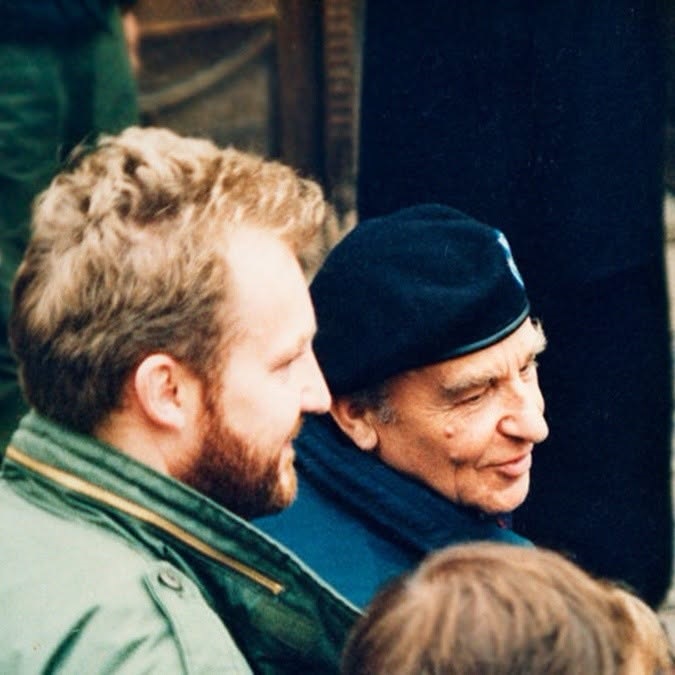
Alija Izetbegović – The Struggle for Freedom and the Principles on Which the Civilized World Rests
— Bakir Izetbegović’s Remembrance of His Father, Alija Izetbegović —
Throughout its thousand-year existence, Bosnia has been the cradle of a spontaneously formed blend of cultures, religions, and identities. It has always been a meeting place between East and West, the Orient and Europe. It was precisely this multiethnic environment in which Alija Izetbegović grew up, together with the turbulent times in which he was educated and shaped, that determined his philosophy of life and his path.
That path was a struggle for the survival and affirmation of his faith, his people, and his country, of which he said: “Bosnia is not merely a piece of land in the mountainous Balkans; it is also the idea that different religions and cultures can live together.” Along that path, he faced the communist secret services, prisons, armies prepared to commit crimes, and wars. They did not frighten him, stop him, or overpower him.
An Ideology Against God
Alija Izetbegović came of age during a period of dramatic social change, upheaval, and the collapse of established orders and relationships—a time of revolutions, aggressive atheization, the rise of fascism and communism, and ideologies without God and against God.
Islam, as a faith and an idea, had almost no influence; it was in decline. The countries and peoples that relied on it, preserved it, and carried it forward were at the back of the pack or on the periphery of historical developments in scientific, technological, organizational, and political terms. Muslims had become the objects of history: they were ruled, they submitted, and, at best, they imitated the technologically and ideologically dominant rulers. The twilight of Islam and the enthusiasm surrounding communism shook Alija’s convictions in his early youth. The proclaimed equality of people, social justice, and the struggle against the fabulously wealthy capitalists who controlled human destinies—all of this appealed to a young man raised according to Islamic principles.
But aggressive atheism, the attempt to replace God with the Party, the failure to respect and the relativization of the sanctity of truth, and collectivism that erased individual freedom were unacceptable to him. His period of wavering and questioning his faith was a very important stage in the formation of Alija Izetbegović as the future Islamic thinker and political leader.
He devoted the first part of his life to defending and reviving Islam and the Muslim world, seeking their place and role in a world that was changing and growing as never before. He set out his ideas about the essence of Islam, which naturally reconciles seemingly irreconcilable opposites, and about a faith that constitutes an integrated worldview and shapes every aspect of life, in his earliest writings as a young man. He then continued to develop these ideas in everything he wrote and published over the following decades.
From Prisoner to Leader
Because of his ideas and written works, he was imprisoned twice. The first time was when he was twenty, immediately after the end of the Second World War; the second time was in 1983, when he was already of retirement age.
Communist courts sentenced him to a total of seventeen years of imprisonment, and he spent almost nine years behind bars. His second imprisonment made him a political leader. He was released from prison in 1988, on the eve of Yugoslavia’s disintegration and the bloody denouement that would strike Bosnia and Herzegovina the hardest. At the age of sixty-five, he founded the SDA, the first alternative political party in the one-party communist system, risking another prison sentence. The communist regime was on its last legs, and there was no new arrest. But the evil that was emerging was far more dangerous than communism. It took the form of radical nationalisms, which threatened not only freedom of religion but also the very survival of the people and the country.
In the mid-1980s, Alija Izetbegović was a prisoner surrounded by the concrete walls of the prison in Foča. By the early 1990s, he was President of the Republic of Bosnia and Herzegovina, surrounded by an impenetrable ring of fortifications and artillery deployed on the hills above Sarajevo.
An Undertaking Difficult to Explain
The defense of Bosnia and the Bosniaks against a two-pronged aggression was a remarkable undertaking, difficult to explain. Well-armed armies from the east and the west attacked a people who were almost barehanded, broke them up into a series of enclaves, and cut them off from the rest of the world. It was estimated that the resistance would last only a few weeks. But the resistance endured and grew stronger. Extraordinary logistical channels were established, the army was organized and armed, and in the final year of the war it gained the military upper hand over the enemy. The liberation counteroffensive of the young Army of the Republic of Bosnia and Herzegovina (ARBiH) was halted in November 1995 by the threat of NATO strikes.
A man in the later years of his life had twice been condemned to defeat, to demise. But he was not defeated, because those who had first sought to destroy him, and then those who followed them, disappeared. Alija remained and outlived them. He outlived some of them biologically, and all of them through his ideas and deeds.
When I ask myself how he managed to do it, although I spent my entire life by his side and observed that struggle at close quarters, I know only part of the answer.
Respect for People
Alija Izetbegović did and was many things throughout his life: a writer, a political dissident, a prisoner, an engineer, a lawyer, a politician, a president, and a father. He managed to do it all, thoroughly and with poise. He possessed exceptional intellectual and working capacity.
His greatest advantage, however, was his temperament, his patience, and the love and respect he showed people. He understood people well. Prisons, politics, and wars bring all their darker sides and weaknesses to light. He spent years observing people under such circumstances and had ample reason to become disillusioned with the human race and to abandon his attempts to improve the world. He never gave up, and he always forgave again and again. A verse from the Holy Qur’an, speaking of the character of God’s final Messenger, surely applies to leaders such as Alija Izetbegović as well: “It was by God’s mercy that you were gentle with them; had you been harsh and hard-hearted, they would have deserted you and withdrawn from you.”
Alija Izetbegović passed away to the Better World on this day in 2003. He undoubtedly belongs among the select and courageous people who made great personal sacrifices in the struggle for freedom and for the principles on which the civilized world rests.
He left us a legacy in his attitude toward the world, toward people, and toward struggle; in the example of his own dedication, kindness, and patience; and in the obligation to prove that Bosnia is not merely “a piece of land in the Balkans,” but an idea that different religions and cultures truly can live together.
Bakir Izetbegović